
Forex traders often chase quick profits, missing the forest for the trees. Long-term strategies reveal market patterns invisible to day traders, with weekly and monthly charts offering clearer signals amid market noise. I’ve watched countless traders burn out from constant monitoring, while those patient enough to wait for 1000-pip movements build sustainable wealth. The market rewards patience, not hyperactivity. Technical analysis becomes remarkably more reliable when you step back, allowing support and resistance to lead you into profits.
tLDR
- Focus on weekly and monthly charts to reduce market noise and identify significant support/resistance zones.
- Implement multi-timeframe analysis to confirm signals across different time periods for higher probability trades.
- Practice patience by waiting for price to reach key structural zones before entering positions.
- Use strategic stop placement beyond reversal zones to protect capital while allowing trades room to breathe.
- Consider trailing stops after gaining substantial profits (300+ pips) to protect gains during long-term market movements.
The Foundations of the 1000 Pips Strategy
Most successful traders understand that achieving significant profits in the forex market requires a methodical approach rather than quick, impulsive actions.
The 1000 Pips Strategy builds on this wisdom by focusing on larger timeframes—weekly and monthly charts—where significant market movements originate.
I’ve found that comprehensive trend analysis across multiple timeframes provides clearer signals than short-term noise.
While many chase quick profits, this strategy demands patience, allowing substantial market movements to develop.
Risk management remains crucial, with stops placed strategically outside reversal zones.
Why Larger Timeframes Lead to Bigger Profits
The wisdom of larger timeframe trading lies at the heart of the 1000 Pips Strategy, providing traders with a panoramic view of the market that simply isn’t available on shorter charts.
This expanded perspective allows traders to identify major support and resistance zones where price action frequently reverses, offering substantial profit opportunities.
Trading psychology benefits tremendously from this approach, as it reduces the noise that often triggers impulsive decisions.
With proper risk management, larger timeframes give traders the confidence to withstand minor fluctuations, knowing they’re positioned for the market’s significant moves that truly matter.
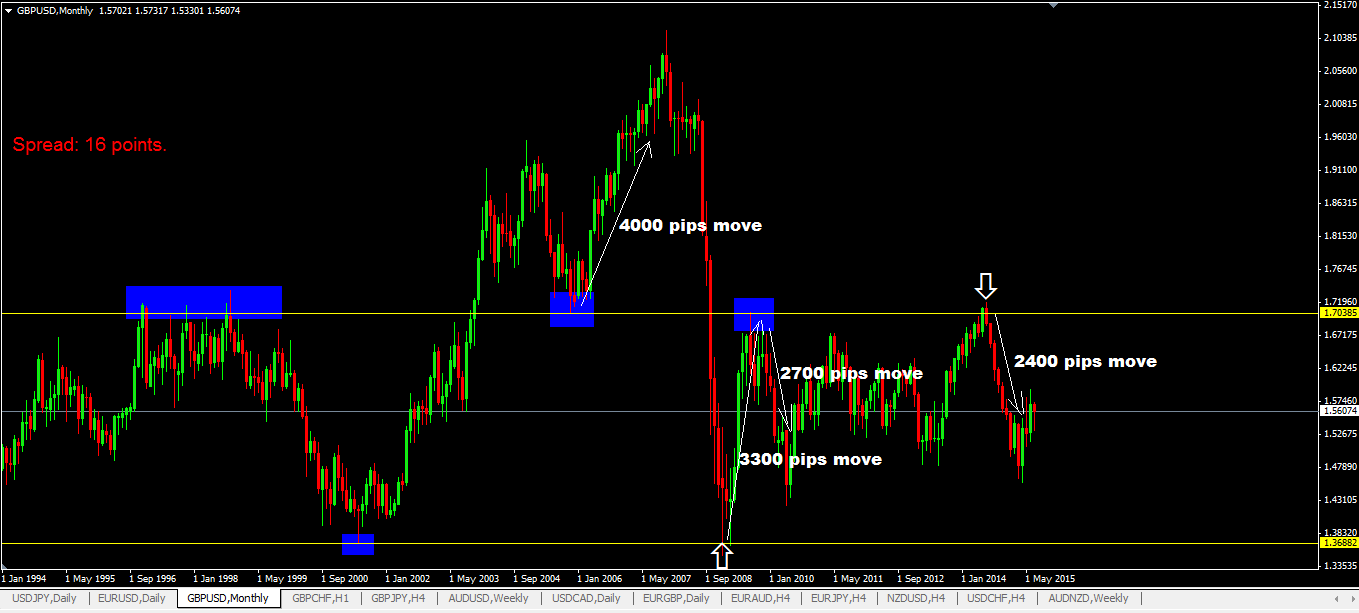
Let me direct your attention to the chart below which illustrates my point. Do you see those support and resistance levels marked by blue boxes? Pay attention to how the price reacted whenever it reached these levels.
Multi-Timeframe Analysis: Connecting the Market Puzzle
While beginner traders typically limit themselves to one timeframe, successful forex professionals know that analyzing multiple timeframes acts as a bridge between apparently unrelated market movements.
The power of multi-timeframe alignment cannot be overstated; when weekly, daily, and 4-hour charts all confirm a trend, your probability of success increases dramatically.
I’ve found that effective trend analysis requires viewing price action through multiple lenses—like examining a diamond from different angles.
Setting Up Your 1000 Pip Trades: Entry to Exit Rules
The trading rules are really simple:
- Identify price levels on weekly or monthly charts where reversals are likely to occur. Look for support and resistance levels, trendlines, channels, and Fibonacci retracement levels.
- As price nears, switch to a much smaller timeframe like the 1hr, 4hr or the daily timeframe and you can place a sell limit/buy limit order depending on which side the price is heading to or you can watch for a reversal candlestick signal and use buy stop or sell stop order and place on the high/low of that reversal candlestick pattern that forms in the zone of the levels mentioned above.
- The stop loss must be placed outside of the zone of these level to avoid getting stopped out prematurely. Or you can also you the daily average movement in pips and use that as a guide to placing your stop loss. For example, if EURSUD has averaged 150 pips move for the last 5 days, then your stop loss should be 150 pips.
- Place your take profit target at 1000 pips.
- And then wait and wait for a very long time. It may take a week, or even 2-3 months before you hit your take profit target level.
Case Studies: Real 1000 Pip Journeys in Major Currency Pairs
Step 1: Identify price levels where potential reversals can occur. On the chart below, the blue box on the left shows a potential resistance level or zone, indicating a sell setup forming on the monthly timeframe.

Switch to a smaller timeframe where you can either place a sell limit order or wait for a bearish reversal candlestick to form. In this example, using the 4-hour timeframe, you’ll notice a bearish candlestick that resembles a shooting star – this is exactly the type of signal you should look for when selling in this situation.

Step 3: Wait patiently and watch your profits grow. Avoid setting your trailing stop loss too close, as this may trigger an early exit from your trade. It’s better to use the daily timeframe to trail your stop loss, and using weekly candlesticks can be even more effective.
This is what happened with the trade setup executed above:

Your Questions Answered
How Long Does It Typically Take to Achieve the 1000 Pip Target?
The 1000 pip target typically takes weeks to months to achieve, as this strategy focuses on long-term position trading.
Successful traders understand that pips accumulation happens gradually across larger timeframes, not overnight.
While some volatile currency pairs might reach targets faster during significant market events, proper risk management dictates patience.
I’ve observed that most traders implementing this approach should expect 1-3 months for their positions to fully develop, depending on market conditions and pair volatility.
Can This Strategy Be Combined With Technical Indicators for Better Results?
Yes, the 1000 Pips Strategy can be improved with carefully selected technical indicators that complement trend analysis without overcomplicating the approach.
While the strategy works effectively on its own, traders often find that adding 1-2 relevant indicators—such as MACD for momentum confirmation or RSI for identifying overbought/oversold conditions—can provide additional validation points.
The key is selecting indicators that align with the larger timeframe setup without creating analysis paralysis or contradictory signals.
What’s the Recommended Account Size for This Long-Term Strategy?
For the 1000 Pips Strategy, traders should maintain a minimum account balance of $5,000-$10,000 to properly implement risk management principles.
This allows for weathering drawdowns during extended trade durations while risking only 1-2% per position.
How Should Correlating Currency Pairs Be Managed Within This Strategy?
When managing correlating currency pairs within the 1000 Pips strategy, traders should conduct thorough correlation analysis to avoid overexposure to similar market movements.
Trade diversification becomes essential, as taking multiple positions in highly correlated pairs effectively multiplies risk exposure. One should either select uncorrelated pairs or reduce position sizes accordingly when trading correlated currencies.
What Psychological Challenges Are Unique to 1000-Pip Long-Term Trading?
Long-term forex trading demands exceptional emotional resilience as positions may remain underwater for extended periods.
Traders often face decision making fatigue when monitoring positions over weeks or months, requiring strong trading discipline to avoid premature exits.
Risk tolerance becomes crucial as market volatility tests one’s conviction in the analysis.
I’ve found that maintaining a trading journal helps combat these psychological challenges, allowing traders to revisit their original thesis when doubt inevitably creeps in.
Conclusion
Long-term forex strategy demands patience and perspective, qualities often overlooked in today’s fast-paced trading environment. By mastering larger timeframes and employing disciplined multi-timeframe analysis, traders position themselves to capture those elusive 1000-pip movements that can transform portfolios. The journey isn’t for everyone, but those who commit to this approach find themselves trading with greater confidence and, ultimately, more substantial profitability in the forex markets.